
Windows Explorer's address bar, on the real Finder.

Switching from Windows? Finder keeps the path out of sight, has nothing you can type an address into, and opens a new window for everything. Floating Finder adds all of it — an editable address bar, two panes side by side — on top of the Finder you already have.

Free for 30 days, every feature · macOS 14 Sonoma or later

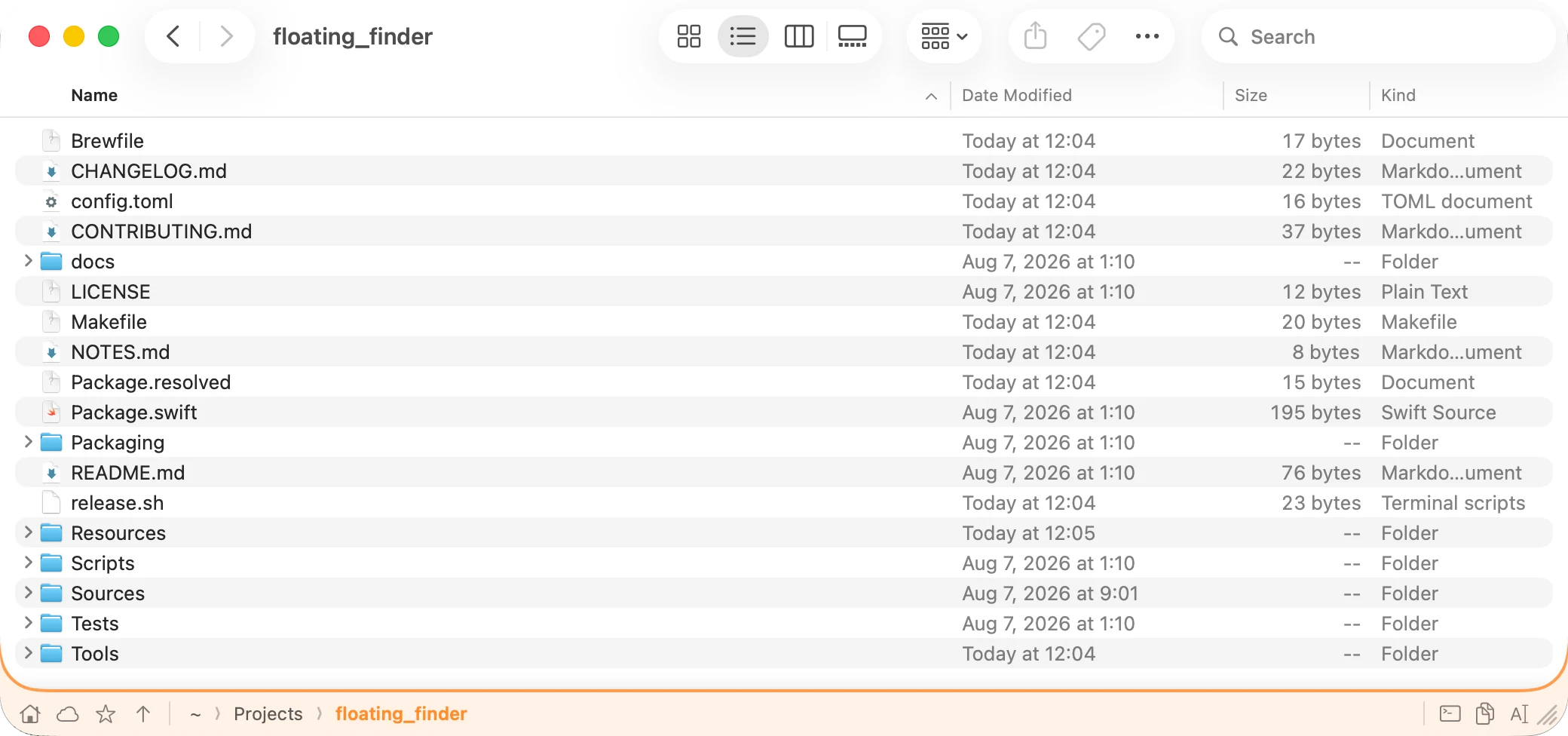
‹ › floating_finder
Packaging Scripts Sources Tests Package.swift1 KB README.md41 KB
🏠 Documents Projects floating_finder >_
The bar is not part of Finder. It tracks the window — move it, resize it, switch spaces, and it stays put. Drawings of the interface, not screenshots. Shown with the orange accent; eight colours and the system accent are available.
Address bar

Always know where you are.

The same breadcrumb address bar you had in Windows Explorer, on every Finder window. Click any crumb to jump up a level. Click the empty space and the bar turns into a field you can type a path into. Copy the full path, open the folder in your terminal, or bookmark it — without leaving the window.

  • Breadcrumb navigation, click to jump
  • Type a path directly and press Enter
  • Copy path to the clipboard in one click
  • Open in Terminal — or whichever terminal app you choose
  • Bookmark folders you keep coming back to

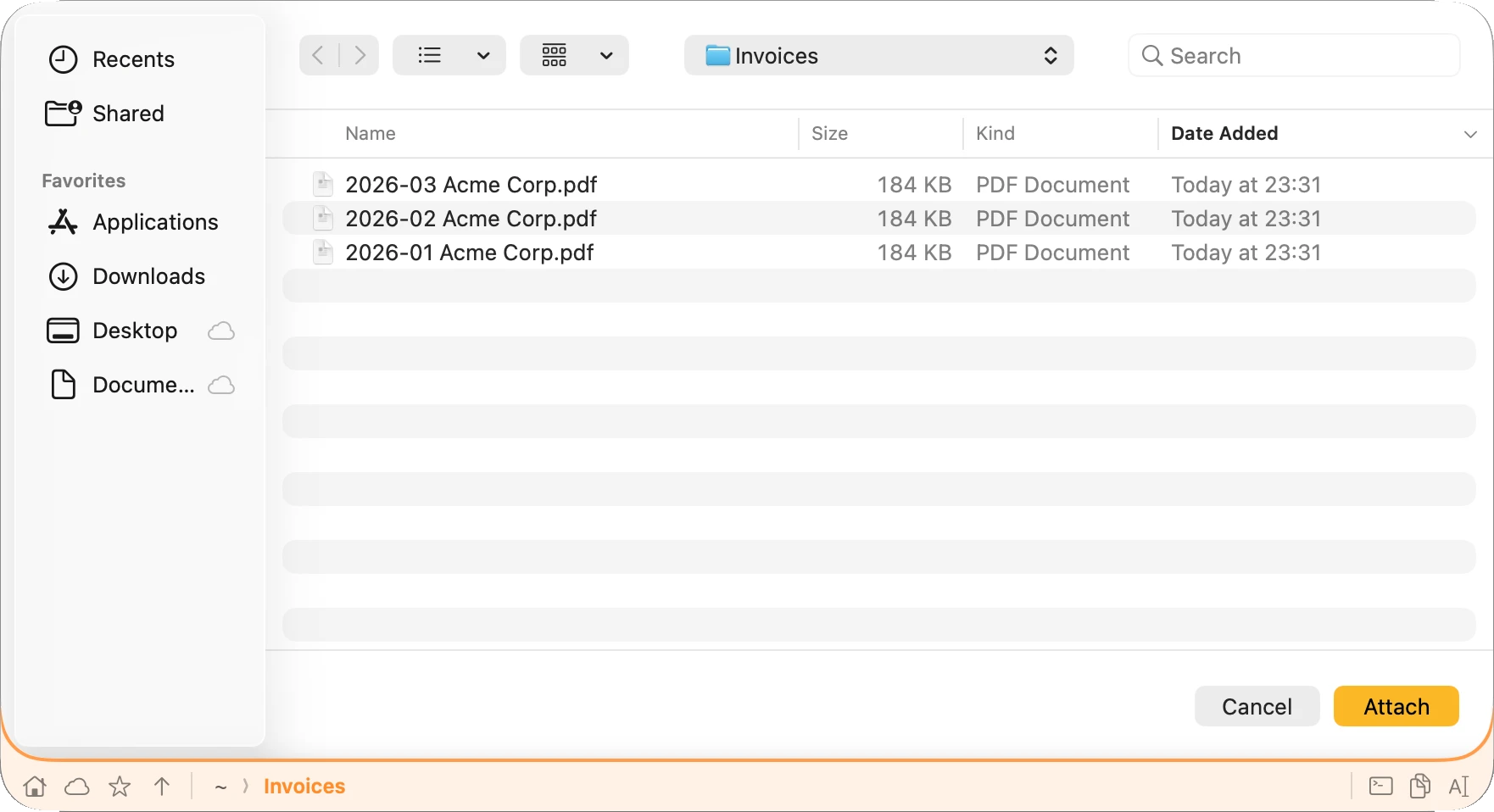
🏠 Documents Invoices >_
~/Documents/Projects/ Enter to go · Esc to cancel
Two panes

Two windows, one pair.

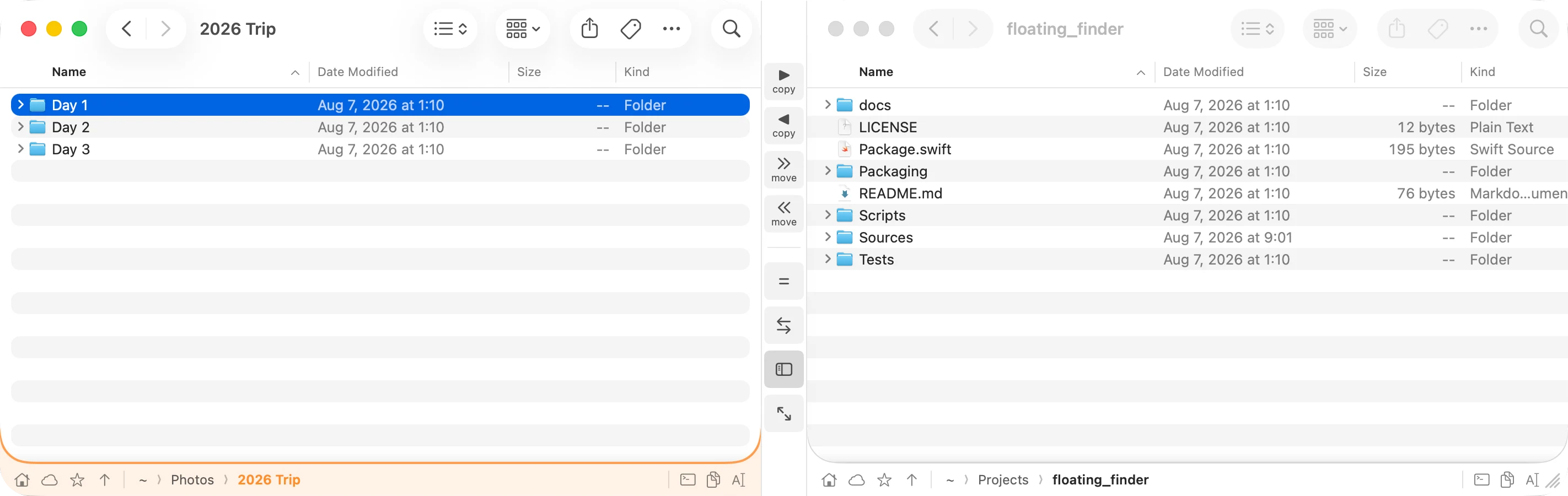
Pick Enable Two Panes from the menu bar and two Finder windows tile into a single pair with a control strip down the middle. Send the selection across with one click — hold to move instead of copy. Mirror one side's location onto the other, swap sides, or fold the sidebars away.

  • Copy or move the selection between panes
  • Open the active pane's folder in the other one
  • Swap left and right
  • Drag the outer edge — the pair re-tiles itself
  • The pair comes back after you quit and relaunch
Camera
IMG_0421.raw IMG_0422.raw IMG_0423.raw IMG_0424.raw
🏠Camera
2026 Trip
Day 1 Day 2 Day 3 IMG_0421.raw
🏠2026 Trip
No window sprawl

New windows stop piling up.

Show in Finder from another app, open . from a shell, a folder double-clicked somewhere else — each one used to leave another window on your screen. While a pair is active, Floating Finder catches the new window, hands its folder to a pane, and closes the leftover before it settles.

It only does this while you're in two-pane mode. Outside of it, nothing closes windows behind your back — that's the deal.

Without
With Floating Finder
Coming from Windows

What File Explorer had, and where it went on the Mac.

Every Windows switcher hits the same wall: the address bar is gone. macOS has a read-only Path Bar you can turn on (View → Show Path Bar), and a separate Go to Folder dialog (⇧⌘G) — but nothing you can look at and type into in the same place. Here's how the habits map over.

In File ExplorerOn the Mac, with Floating Finder
Address bar at the top, click a crumb to jump Breadcrumb bar along the bottom of the window, click a crumb to jump
Click the address bar, type C:\Users\…, Enter Click the empty part of the bar, type ~/Documents/…, Enter
Copy the path out of the address bar One click on the copy button in the bar
Two Explorer windows snapped side by side Two Finder windows tiled as a pair, with a strip of controls between them
Drag files between the two windows Drag, or press one button to send the selection across (⌥ to move)
Quick access / pinned folders Bookmarks, from the star in the bar
Open a terminal at the current folder A button in the bar, pointed at whichever terminal app you use
The address bar is there in Open and Save dialogs too So is this one, in other apps' dialogs

What it doesn't bring over

Worth knowing before you download, because none of it is planned soon:

  • No folder tree pane — Finder's sidebar is what you get
  • No keyboard shortcuts yet: everything is a click or the menu bar
  • No cut & paste of files. macOS does this natively — copy with ⌘C, then ⌥⌘V pastes as a move
  • No tabs, no ribbon, no file operation queue
  • It isn't a file manager. If you want to leave Finder behind entirely, a full replacement app is a better fit than this

And the small things.

An address bar in dialogs, too

Open and Save sheets in other apps get the same breadcrumb — and you can type any path into it.

Lives in the menu bar

No Dock icon, no window of its own. It's there when Finder is, and invisible otherwise.

Pick an accent

Eight path bar colors, or follow the system accent. Light and Dark both handled properly.

English · 日本語 · 简体中文

The whole interface, not just the menus. It follows your system language.

Resize from the bar

The bar covers Finder's bottom edge, so it takes over the job: drag its lower edge or the corner grip.

Tells you when it's unhappy

A built-in health check reports which permission or dependency is missing, instead of silently doing nothing.

It is still Finder underneath.

Nothing is reimplemented. Quick Look, tags, sorting, column view, extensions, iCloud, your sidebar, your muscle memory — all of it is the Finder Apple shipped. Floating Finder reads the windows and draws on top. Quit it and you're back to plain Finder, immediately, with nothing left behind.

Five dollars. Once.

$5one-time
  • Every feature, no tiers
  • 30-day free trial — no account, no card
  • Not a subscription, and never will be
  • Up to 3 Macs
Buy a license Try it free first

Payments and license keys are handled by Polar.

Questions.

Does the Mac Finder have an address bar like Windows Explorer?

Not really. Finder has a Path Bar you can switch on (View → Show Path Bar, ⌥⌘P) that shows the folders above you and lets you double-click one to jump — but you can't type into it. Typing a path means a separate dialog, Go to Folder (⇧⌘G), which disappears again once you've used it. Floating Finder is the missing half: the same bar, but you can click into it and type.

How is this different from Finder's built-in Path Bar?

The built-in one only shows. This one acts: type a path into it, copy the path, open the folder in a terminal, bookmark it, and drag its lower edge to resize the window. It also stays with the window when you move it, and it's the same bar in other apps' Open and Save dialogs, which the built-in Path Bar never appears in.

Does it replace Finder?

No. It's a companion that runs alongside Finder and draws floating UI over the real windows. Your Finder settings, extensions and habits are untouched.

Why does it need Accessibility permission?

That's the only supported way for an app to read another app's window positions and contents. Floating Finder uses it to know where each Finder window is, so the path bar can sit on it and follow it. Without the permission, nothing appears.

And the Automation permission?

Apple Events are how it tells Finder to do things: change a window's folder, copy or move the selection, open a second window. macOS asks you to approve Floating Finder → Finder the first time. Without it, the display works but the actions don't.

What about Full Disk Access?

Optional, and only for one case: moving files between protected folders like Documents, Desktop and Downloads. Copying and normal dragging don't need it. If a move quietly fails, that's the setting to check.

What happens when the trial ends?

You get an occasional, unaggressive reminder to buy a license. Nothing is disabled and nothing locks up. Buying is how you make the reminder stop — and how this keeps being worth maintaining.

Which macOS versions are supported?

macOS 14 Sonoma and later. Development and testing happen on the current macOS release, on Apple silicon.

Does it slow the Mac down?

It reacts to events rather than redrawing on a loop: it wakes when Finder reports that a window moved, resized or changed folder. Sitting idle, it does essentially nothing.
